Presentation Skills in the AI Era: Should You Let ChatGPT Take Over?


As a Professional Presentation Coach & Trainer (yes, I do wear many hats! 😄), I've been pondering a question that came up during the Q&A session at last week's "Sea Course Education - AI Lecture." It was an excellent question that deserved a more in-depth answer than I could provide on the spot: Do we still need to learn presentation skills in the age of AI and ChatGPT?
Coincidentally, I received a speaking invitation for April. It's a lecture series called "104 Senior Life Second Half Breakthrough" organized by 104 Job Bank's platform. The event features an impressive lineup of speakers: Charles discussing career transitions, Frank talking about technology, Dr. Lee sharing insights about marriage, Amanda exploring interpersonal relationships, and our familiar host Ken speaking about life purpose. I'm honored to be invited to speak about learning, delivering a 20-minute presentation titled "Second Half of Life, Being Your Best Self: Transforming Life Through Learning."
For new topics like this, I typically spend a significant amount of time in preparation (yes, truly significant!) - from conceptualizing the theme and brainstorming content to structuring the presentation flow, creating slides, and rehearsing before the actual delivery. Each important presentation consumes countless hours... (which is why I don't often accept speaking invitations).
But with the AI revolution, particularly with ChatGPT, and given my familiarity with prompting techniques (see my previous articles on Prompt Techniques Part 1 and 2, and my conversation with AI in late 2022), why not explore how AI could help? Could it save me time? Improve quality? More importantly: How can we leverage these tools to enhance our presentation skills in the age of AI?
Step 1: Preparation - Think It Through Yourself First
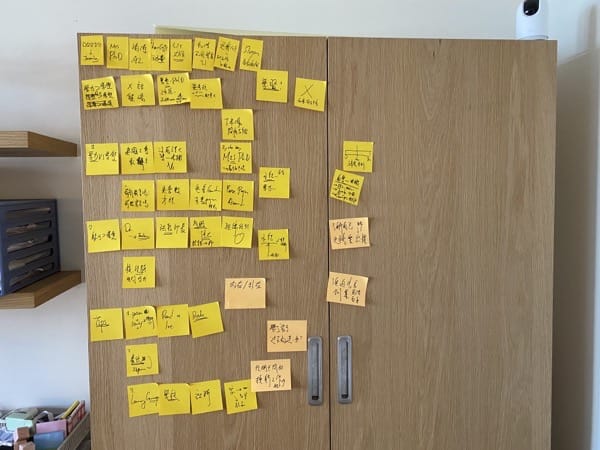
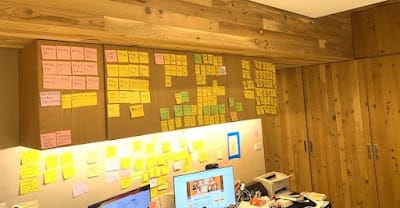
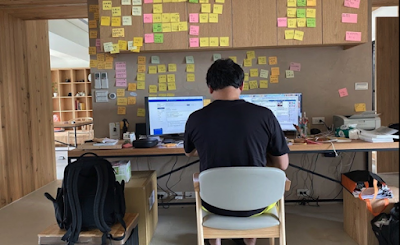
To be honest, before letting AI help with my presentation, my biggest concern wasn't whether it could generate content, but rather whether its ideas would "contaminate" my own thinking. I wasn't worried about the quality of AI's thoughts, but rather that if I started with AI-generated content, this presentation would "no longer be my presentation!" Plus, this way, I could better compare the results with and without AI intervention. So I took a relatively "old-school" approach: I thought it through myself first! Using sticky notes for ideation, I mapped out the general content I wanted to cover and arranged my intended presentation flow.
Surprisingly, this "old-school" method turned out to be the most crucial part, influencing all subsequent steps.
Step 2: Using AI for Content Generation
One of the biggest challenges people face when preparing presentations is not knowing what to say. As ChatGPT users know, it excels at content generation - it can talk about anything, and quickly too. However, getting quality content still requires some technique.
When you simply ask it to "Please generate content for a presentation," it generates generic yet uninspiring content—like a scripted public service announcement! For example:
"The arrival of life's second half should be an opportunity to reassess our life goals and values. It's a moment to evaluate what we've done right and wrong, examine whether we've achieved our dreams, and consider if we've reached the life we wanted."
Sounds polished, right? But think about it - anyone could say this. Are your presentations falling into this trap?
Step 3: Focused Refinement
For a 20-minute presentation, structuring it into 3-4 main sections usually works well. I gave ChatGPT this prompt:
"Since the presentation is only 20 minutes long, if I want to divide it into 3 main sections, what would you suggest? What key points should be covered in each section?"
Using Level 2 Prompt Techniques, it generated an impressive structure in less than 30 seconds, breaking the content into three clear sections: challenges and importance of learning, practical methods, and future strategies. The quality was remarkable - worthy of 80 points out of 100! From problem identification to practical solutions and future outlook, the structure was solid.
I later fed it my sticky note ideas, and it produced suggestions even more aligned with my needs... The whole process felt like brainstorming with an ever-ready assistant!
Human Value: What Makes Us Irreplaceable
At this point, you might be thinking, "Why not let AI handle everything and skip thinking altogether?" But let's consider what makes humans irreplaceable:
- Our experiences, struggles, and genuine feelings - things AI can analyze but never truly experience
- The passion and inspirational energy we bring to live presentations
- Our creativity and those unexpected moments of brilliance - elements of originality AI struggles to replicate
This brings us back to what I mentioned at the beginning: the most important part was thinking through the content myself before involving AI. With this foundation, I could then consider which aspects could benefit from ChatGPT's input to make them even better.
In this AI age where content is becoming commoditized, maintaining personal characteristics and uniqueness becomes even more valuable.
Professional Presentation Coach's Advice
1. If AI can generate your presentation in a minute, what does that say about your value as a speaker?
2. In the AI era, what matters isn't just content, but how you express it and your impact - something AI currently can't match.
3. This is the key to staying relevant: understand tools, use them wisely, but don't depend on them. Know about AI and use it, but don't fear it or rely on it entirely. Maintaining a healthy relationship with AI tools is crucial moving forward.
4. Should you learn presentation skills in the age of AI? Here's the truth: knowing and doing are two very different things! ChatGPT can tell you what to do - just like many books can - but when you're actually presenting, it's all up to you!
Of course, ChatGPT can help with more than just content. It can assist with presentation flow, designing openings, and crafting conclusions. Tools like Office 360 CoPilot or Canva can generate presentation files, and ChatGPT can even serve as a consultant for audience perspectives. I'm experimenting with all these approaches and will share my insights in future articles (If only I could type as fast as ChatGPT... 😅).
In Conclusion:
In this new AI era, using ChatGPT to increase productivity is a trend every professional should embrace. With basic prompting skills and good reference materials, AI can quickly produce solid presentation content. But that raises an important question: if everyone has access to this baseline quality, how do we stand out?
More importantly, how do we harness AI without letting it diminish our individuality? How do we maintain the right balance, letting it enhance rather than replace our unique value?
If the baseline starting point is now 80 points, do you think competition will be less or more intense? Something worth pondering.
Finally, you're welcome to join the "104 Senior Life Second Half Breakthrough" lecture series. I guarantee it's straight from my mind—not an AI-generated script! Who knew originality would become a competitive edge in the AI era! 😄
---
*Written by Dr. Jeff Wang, author of "Techniques of Teaching" and "Work-Life Balance Techniques"*