Gamification in Training and Teaching
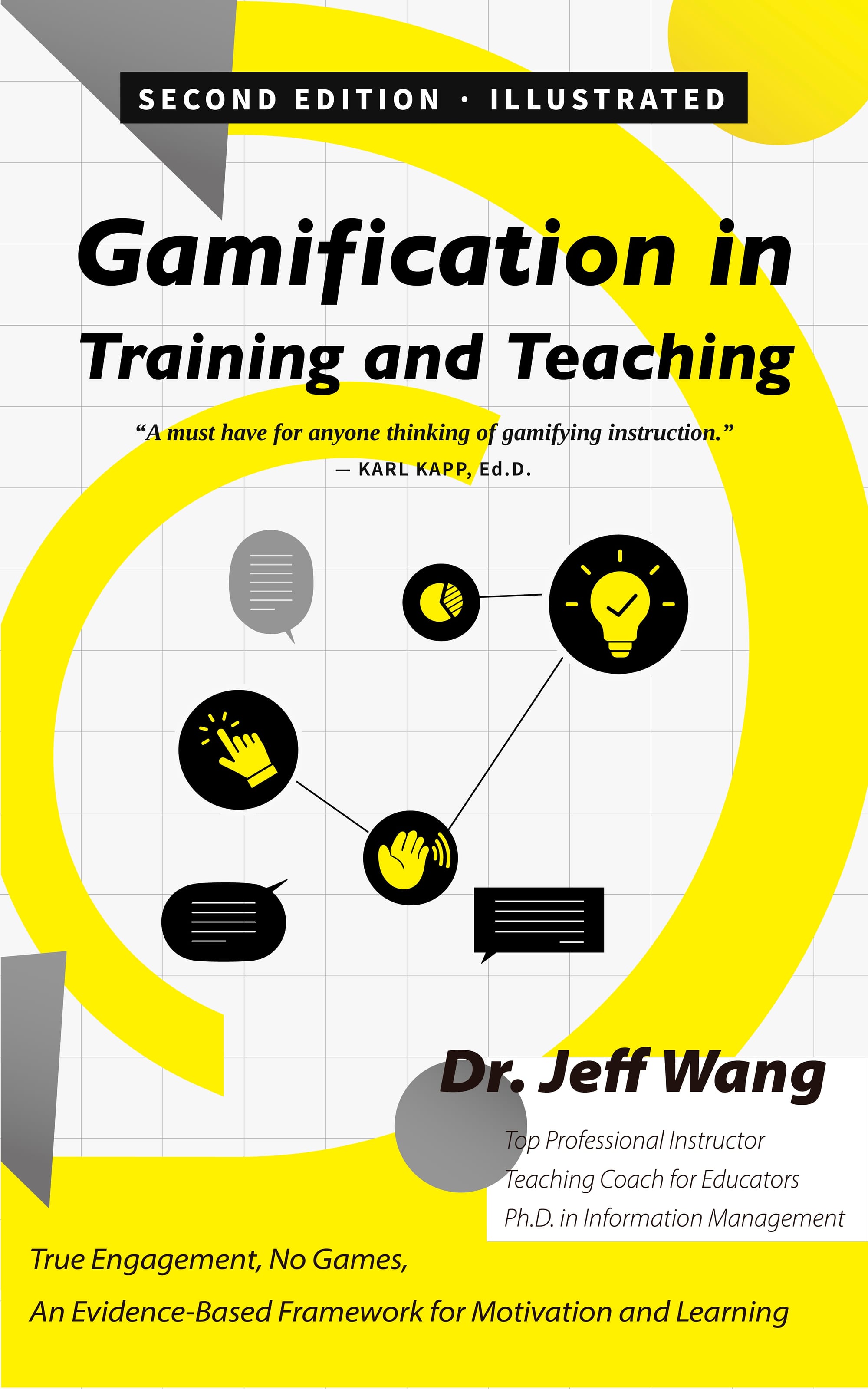
Second edition · Illustrated · Kindle and paperback · January 2027
True Engagement, No Games, An Evidence-Based Framework for Motivation and Learning
By Dr. Jeff Wang · 326 pages · 7 diagrams · printable AFFECT checklist
“A must have for anyone thinking of gamifying instruction.”
— Karl Kapp, Ed.D., Professor of Instructional Design and Technology, Commonwealth University
Stop playing games. Start engaging learners.
Gamification becomes decoration when its points, rewards, or rankings are disconnected from the learning objective. This book shows trainers and teachers how to connect them to the teaching task, so learners participate, practice, and remember.
Dr. Jeff Wang asked a practical question: which elements actually matter? In a Delphi study, 14 experienced corporate trainers rated 35 candidate game elements over three rounds. The highest scores went not to points or badges but to the design of the activity itself: six design principles that this book calls the AFFECT framework.
- Aligned goals — every activity serves a learning objective
- Feedback, immediately — learners see results right away
- Fair & clear rules — rules anyone can follow in a minute
- Escalating challenge — start easy, raise the bar as skill grows
- Competition in teams — teams, not individuals, carry the energy
- Try without risk — practice where mistakes cost nothing
These are six principles, not six steps. A good lesson needs all of them working together. See the research behind AFFECT →
New in the second edition
- The AFFECT framework, with a printable checklist you can use on any lesson plan
- The new PBL: Points, Benefits, and Leaderboards — and why badges were not rated a key element in the study
- Seven new diagrams, redrawn for print, including the six AFFECT principles, the new PBL, and the flow channel
- Key Takeaways and a “Try this tomorrow” action at the end of Chapters 1–6
- Re-edited for an international audience; learning theory checked against original sources
- The research in plain English, with links to the published papers
Who it is for
- Corporate trainers, L&D and HR professionals
- Instructional designers, facilitators and coaches
- Teachers, university faculty and medical educators
- Anyone who teaches and wants learners to do more than listen
Not a catalog of icebreakers. This is a design method, with real cases from training rooms, hospitals and classrooms.
What leaders in gamification say
“For educators, this book serves as a bridge, helping you transform abstract gamification concepts into actionable and impactful strategies.”
— Yu-kai Chou, author of Actionable Gamification
“…deftly explores, explains, and extends this vital concept.”
— Curtis J. Bonk, Distinguished Professor, Indiana University
The research behind the book
The framework comes from two Delphi studies on gamification — one in corporate training (Entertainment Computing, Best Paper of 2022) and one in medical education (Medical Education Online, 2024). Both rank among the top 1% most-cited papers in their field and year; the medical-education study is in the top 0.1% (OpenAlex). Read about the research →
For educators and training teams
- Teaching a course or running a train-the-trainer program? Request a free examination copy: email afuwang@gmail.com with your name, your institution or company, the course or program you are considering it for, when it runs, and roughly how many learners. Examination copies are for instructors evaluating the book for a course or program. Before publication, copies are sent as a PDF; after publication, as a paperback or Kindle book. Pre-publication copies are limited.
- Bulk copies, workshops built on the book, translation or publishing partnerships: afuwang@gmail.com
About this edition
The second edition is translated and adapted from Dr. Wang’s Chinese book The Art of Gamified Teaching, first published in 2022 and a 2023 annual bestseller at Books.com.tw, Taiwan’s largest online bookstore. It is his 11th book and his first in English.
Want practical teaching ideas, classroom cases, research, and news about the second edition? Subscribe to the free newsletter →